
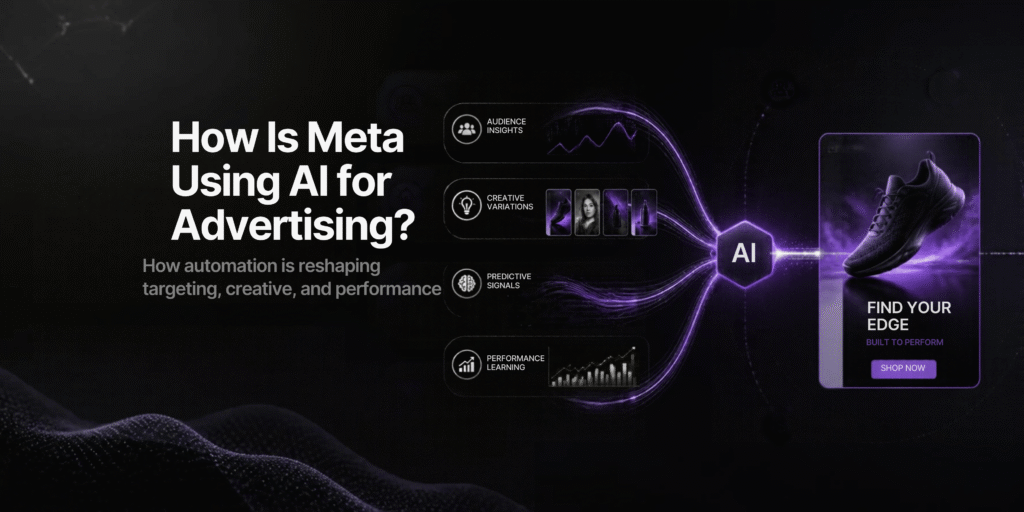
How Is Meta Using AI for Advertising?
If you see an advertisement for a product that matches your interests while scrolling through Instagram or Facebook, artificial intelligence may be helping decide which ad appears in your feed.
Meta uses AI to understand user interests, recommend relevant advertisements, automate campaign delivery, and help businesses create advertising content. Its AI-powered advertising tools are also changing how marketers approach audience targeting, creative testing, and campaign optimization.
For businesses, this means advertising is becoming more automated. Instead of manually controlling every targeting option and campaign setting, advertisers can use Meta’s AI systems to make certain decisions based on campaign objectives and performance signals.
But how does Meta actually use AI for advertising, and what does it mean for digital marketers?
What Is Meta AI Advertising?
Meta AI advertising refers to the artificial intelligence and machine learning technologies Meta uses to deliver ads and help advertisers manage their campaigns across platforms such as Facebook and Instagram.
These technologies support several activities, including:
- Identifying people who may be interested in a product or service.
- Selecting which advertisements to show to different users.
- Automating campaign targeting and delivery.
- Generating or improving ad images, videos, and text.
- Optimizing advertising performance toward selected goals.
- Personalizing recommendations based on relevant activity and signals.
Meta’s Advantage+ suite is one example of its AI-powered advertising tools. It helps automate parts of campaign setup, audience selection, creative optimization, and ad delivery, depending on the campaign type and features available.
The objective is to help advertisers reach relevant audiences and manage campaigns more efficiently. However, AI does not guarantee better results for every business.
How Is Meta Using AI for Advertising?
1. AI Helps Show Ads to Relevant Audiences
One of Meta’s major uses of AI is deciding which advertisements are most relevant to individual users.
Facebook and Instagram have large audiences with different interests, behaviours, and preferences. Showing the same advertisement to everyone would not be equally useful for every business.
Meta’s advertising systems use machine learning models to evaluate relevant signals and predict which ads may be most appropriate for a particular person in a particular context.
For example, a person who regularly engages with fitness-related content may be more likely to see advertisements for workout equipment or sportswear.
This does not mean every advertisement is based on a single action. Ad delivery involves multiple signals, campaign settings, advertiser objectives, and applicable privacy and advertising policies.
What this means for marketers: You do not always need to define every audience characteristic manually. AI-assisted targeting can help discover potential customers beyond an advertiser’s initial assumptions.
2. Meta Advantage+ Automates Campaign Management
Meta Advantage+ is a collection of AI-powered advertising solutions designed to automate parts of campaign management.
Depending on the campaign and available features, advertisers can use automation to support audience selection, budget allocation, placements, and creative optimization.
For example, an online clothing store wants to increase purchases through Instagram and Facebook ads.
Instead of manually creating numerous audience combinations and adjusting every placement separately, the business could use a suitable Advantage+ campaign to automate selected decisions.
The advertiser can then focus on other important areas, such as product selection, pricing, creative quality, and customer experience.
However, automation still requires careful setup. Advertisers need to select suitable objectives, configure budgets, measure conversions, and evaluate the quality of the results.
Learn more through Meta for Business.
3. AI Helps Create Ad Images, Videos, and Text
Creating advertising content can take considerable time, especially when a business needs multiple versions of an advertisement for different audiences and placements.
Meta has introduced generative AI features in its advertising tools to help advertisers produce or modify creative assets.
Depending on availability and campaign settings, these features can help with:
- Generating variations of advertising text.
- Creating or editing images.
- Expanding images to fit different placements.
- Producing video variations.
- Adapting creative assets for different advertising formats.
For example, a small business selling handmade jewellery might start with one product photograph. AI-assisted creative tools could help adapt the image for a vertical placement or generate alternative creative variations.
The business can then review the assets and decide which ones accurately represent the product and brand.
Meta’s advertising tools also support creative adjustments for formats such as Reels. See Meta’s guide to Reels advertising.
Why this matters: AI can reduce some creative production work, but advertisers should still review product details, image accuracy, messaging, and brand consistency before publishing.
4. AI Helps Optimize Campaign Performance
Launching an advertisement is only the beginning of a campaign. Marketers must also understand which campaigns generate meaningful results and where advertising spend is being used effectively.
Meta’s AI systems can help optimize ad delivery toward the objective selected by the advertiser.
For example, a campaign designed to generate purchases may use different optimization signals from a campaign focused on brand awareness.
Meta also continues to develop larger AI recommendation models. In its October 13, 2026 engineering update, the company described an expanded Generative Ads Recommendation Model (GEM) designed to improve ad recommendations across its advertising ecosystem.
These systems help determine which ads to deliver, but advertisers must still evaluate business outcomes using campaign reporting and their own sales or lead data.
Practical recommendation: Do not judge campaign performance only by likes, impressions, or clicks. Review cost per qualified lead, purchases, revenue, and return on ad spend (ROAS) when those metrics are relevant to your business.
5. AI Can Help Advertisers Find New Customers
A business may begin advertising with a clear idea of its target audience. However, its next customer might not match every characteristic in that initial audience definition.
AI-assisted audience tools can use advertiser-provided information and relevant platform signals to help identify additional people who may be interested in an offer.
Meta’s Advantage+ Audience, for example, can use audience suggestions and AI-assisted delivery to expand reach beyond an advertiser’s initial suggestions where the campaign supports it.
Consider a hypothetical online skincare store targeting customers who have previously interacted with its brand. AI-assisted targeting may help the campaign reach other people who show relevant signals of interest.
This can help businesses explore new audiences, but broader reach does not automatically mean more profitable customers.
Advertisers should monitor conversion quality, customer acquisition costs, and campaign performance before increasing budgets.
6. Meta Uses AI to Personalize Ad Recommendations
Meta also uses AI to personalize the advertising experience people receive across its platforms.
In an October 2025 announcement, Meta explained that it would begin using interactions with its AI features to personalize content and ad recommendations from December 16, 2025, in most regions covered by the rollout.
For example, if someone interacts with Meta AI about hiking, that interaction may help Meta infer an interest in hiking-related content. The person might subsequently receive relevant recommendations, including advertisements for hiking equipment.
Meta says its personalization practices are subject to its policies and controls, and it excludes certain sensitive topics from being used for advertising personalization.
This illustrates how AI interactions can become another signal in Meta’s recommendation systems, alongside other relevant activity.
7. AI Is Expanding Into Advertiser Support
AI is not limited to deciding which advertisements users see. It can also help advertisers manage their accounts and understand campaign performance.
In January 2026, Meta announced that it had begun testing a Meta AI business assistant with advertisers. The planned capabilities included helping with optimization and account support, with an expansion to more businesses expected in the following months.
The company described the assistant as a way for advertisers to receive personalized recommendations based on their goals.
Availability can vary, so advertisers should check their own Meta Business tools rather than assume the assistant is available in every account.
For marketers, AI-assisted support could make it easier to investigate campaign issues, understand recommendations, and identify potential optimization opportunities.
What Does Meta AI Advertising Mean for Digital Marketers?
Meta’s growing use of AI changes which skills advertisers need to prioritize.
Manual targeting and repetitive campaign adjustments remain relevant in some situations, but marketers also need to understand how to guide automated systems and evaluate their results.
Here are four practical implications.
Creative quality matters. When campaign delivery becomes more automated, clear messaging and compelling creative assets can help businesses communicate their value to potential customers.
Conversion tracking matters. AI optimization depends partly on the signals available to the advertising system. Inaccurate tracking can make it difficult to evaluate results or optimize toward the right outcome.
Testing still matters. AI does not eliminate the need to test different offers, messages, landing pages, and creative approaches.
Business goals matter more than vanity metrics. A campaign with high engagement may still be unsuccessful if it generates few qualified leads or profitable sales.
The marketer’s role is increasingly about setting the right objective, providing useful inputs, monitoring results, and making informed decisions.
How Can Businesses Start Using Meta AI for Advertising?
Businesses that want to use Meta’s AI-powered advertising features can follow these steps.
Step 1: Define Your Campaign Objective
Decide what you want your campaign to achieve.
Your goal might be website purchases, qualified enquiries, app installations, or brand awareness. Choose the objective that aligns with the result your business needs.
Step 2: Set Up Accurate Tracking
Check that your website events and conversions are measured correctly. Depending on your setup, this may involve the Meta Pixel, Conversions API, or other supported measurement tools.
Make sure the events being tracked reflect meaningful business actions rather than accidental clicks or irrelevant interactions.
Step 3: Prepare High-Quality Creative Assets
Create accurate, relevant images, videos, and advertising copy. You can use supported AI tools to generate variations or adapt creative assets, but review everything before publication.
Avoid misleading product images, unsupported claims, and content that could violate advertising policies.
Step 4: Test Suitable Automation Features
Explore the Advantage+ features available for your campaign type. Start with settings that match your objective and business requirements.
Do not enable every available feature simply because it uses AI. Consider what each feature does and whether it addresses a genuine campaign need.
Step 5: Monitor Results and Adjust
Review campaign performance regularly. Examine spending, conversions, cost per result, lead quality, and revenue where applicable.
If the campaign is not meeting its objectives, investigate possible causes before making major changes. These might include an unsuitable offer, weak creative, poor landing-page experience, tracking problems, or irrelevant traffic.
What Are the Limitations of Meta AI Advertising?
Although AI can automate several advertising tasks, it has limitations.
AI cannot fix a weak offer. If customers do not see value in your product or service, automated delivery alone is unlikely to solve the problem.
Automation can still produce poor results. Campaign performance depends on the objective, available data, creative quality, competition, and other factors.
Generated content needs human review. AI-created images or copy may contain inaccuracies or communicate something that does not match the real product.
Advertisers need to understand their data. Automated optimization does not remove the need to evaluate lead quality, revenue, profitability, and measurement accuracy.
Privacy and policy requirements still apply. Advertisers must comply with Meta’s advertising policies and applicable data protection requirements when collecting or using customer information.
The best approach is to use AI where it adds value while maintaining human oversight of campaign strategy and business decisions.
Final Thoughts
Meta is using AI to change both sides of digital advertising: how advertisements are created and managed, and how they are selected for individual users.
Tools such as Advantage+, generative AI creative features, and increasingly advanced recommendation models can help advertisers automate tasks, explore audiences, and optimize campaign delivery.
However, AI is not a replacement for understanding customers, developing a compelling offer, measuring conversions, or making sound marketing decisions.
For businesses and digital marketers, the practical opportunity is to combine AI-assisted automation with accurate tracking, relevant creative content, and continuous performance evaluation.
The key takeaway: Use Meta AI to make advertising more efficient, but judge its success by the business results it helps you achieve.