How Is AI Changing Organic Search Visibility?
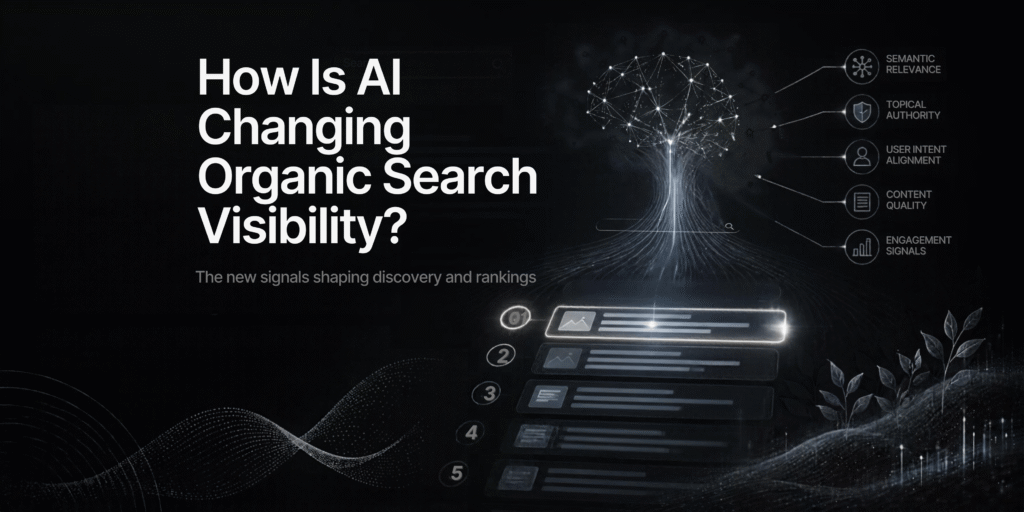
For years, “organic visibility” mostly meant one thing: where your page ranked. That’s no longer enough. Today your brand can show up in three different ways: as a blue link, as a source cited inside an AI answer, or as a name mentioned in that answer with no link at all. Each behaves differently, and each needs a different response.
Here’s what the research shows about each change, and what you can do about it.
Change 1: Rankings now bring fewer clicks
The first change is the one most marketers have already seen in their reports. When an AI Overview sits above the results, the same ranking earns fewer clicks.
Studies disagree on how many. Seer Interactive’s large dataset put organic CTR at 0.61% on queries with an AI Overview, versus 1.62% without one. Ahrefs estimated a 58% lower average CTR for the top-ranking page when an AI Overview was present. A randomized experiment, which can show cause rather than just correlation, found that AI Overviews cut organic clicks by 39.8%.
So the true effect probably sits somewhere in a wide range, and it varies by query type. What’s consistent is the direction. Ranking #3 for an informational query today is worth less than it was two years ago.
Change 2: Being cited matters more than being ranked
Here’s the part that surprises people. Ranking well and getting cited by an AI are related, but they’re not the same thing, and the gap seems to be growing.
Moz studied nearly 40,000 queries in Google’s AI Mode and found that 88% of AI Mode citations were not in the organic results for the same query. For AI Overviews, one analysis says the overlap between top-ten results and cited sources fell from about 76 percent in mid 2025 to somewhere between 17 and 54 percent in early 2026.
Those two findings measure different Google surfaces (AI Mode versus AI Overviews) and different samples, so don’t merge them into one number. Together they suggest that AI systems pull from a wider net than the first page of results, partly because they break one question into several related searches.
Being cited is worth the effort. Seer found that brands cited in an AI Overview saw 35% higher organic CTR than uncited brands on the same queries. A citation doesn’t just give you a link. It makes the other links to you more likely to be clicked.
Change 3: Mentions and citations are different things
This distinction matters for how you report results to clients. Semrush separates the two: a mention is when an AI system names your brand in its answer, while a citation is when it quotes from your own website as a source.
In practice, AI often names brands without linking to them. In one Ahrefs analysis of its own brand across six AI platforms, links appeared as rarely as 10% of the time for AI Overviews and as often as 50% for Perplexity. That’s one company’s data, so treat it as an example, not an industry average.
The traffic gap between platforms is also large. Ahrefs data cited by one roundup says ChatGPT handles roughly 12% of Google’s search volume but sends 190 times less traffic to websites. A mention can build awareness and influence a buying decision without producing a single trackable session, which means a standard analytics report will undercount it.
Change 4: Visibility is increasingly built off your own website
If AI systems draw from a wide net, what’s in it? A lot of it is content you don’t control.
In Semrush’s index of AI search prompts, YouTube led Google AI Overviews with 35.2 million mentions, more than double the next brand, Reddit, at 15.2 million. Moz similarly noted that platforms like Reddit, YouTube, Facebook, and LinkedIn account for a meaningful share of AI Mode citations.
Ahrefs studied 75,000 brands and found that branded web mentions correlate strongly with AI visibility, in the 0.66 to 0.71 range. A word of caution: correlation isn’t proof that mentions cause visibility. Well-known brands attract more mentions and more AI visibility for the same underlying reason, which is that they’re well known. But the finding fits a simple idea: AI answers lean on brands that the wider web already talks about.
What hasn’t changed
It would be a mistake to read all this as “forget SEO.” Google’s May 2026 guide on generative AI features says its AI search is built on its core ranking and quality systems, drawing on pages from the Search index. The guide says creating unique, compelling, useful content will likely do more for your presence in AI search than any other tip it lists. Pages that can’t be crawled or indexed have no chance of being cited at all.
So the foundations still count. What’s changed is that they’re now the entry ticket, not the whole game.
A hypothetical example
Imagine a small accounting software company that ranks well for “how to file GST returns” but sees clicks fall. It checks Search Console and finds impressions steady while CTR dips, a classic sign of an AI answer absorbing the click. It then searches the same question in AI Overviews and ChatGPT and sees three competitors named, with itself missing.
Its next steps wouldn’t be to publish 50 more blog posts. They might be a short video walkthrough on YouTube, a detailed guide with screenshots from real filings, and a few answers on forums where its customers actually ask. This scenario is invented to show the thinking, not a reported result.
What to do about it
- Report three layers, not one. Track rankings and clicks, citations (is your site being linked?), and mentions (is your brand being named?). Search Console covers the first. For the others, you can manually test a set of 20 to 30 important questions each month and log the results, or use a paid tool such as Ahrefs Brand Radar or Semrush’s AI visibility tools.
- Separate query types. Informational queries are the most exposed. Local and transactional queries are usually steadier. Diagnose the right group before reacting to a traffic drop.
- Make pages easy to cite. Give clear answers early, back claims with named sources, and include original data or firsthand detail. Avoid generic text that says what everyone else says.
- Show up where your audience talks. If YouTube, Reddit, and LinkedIn feed AI answers, a presence there is part of search visibility. Participate honestly. Google specifically warns that seeking inauthentic mentions is unlikely to help.
- Keep the technical basics clean. Crawlability, indexing, fast pages, and accurate local and product details.
- Tie everything to outcomes. Calls, leads, and sales matter more than a visibility score. Whatever dashboard you build, connect it to revenue events.
The takeaway
AI hasn’t ended organic visibility. It has split it. Rankings still matter, but they now sit alongside citations and brand mentions, and both of those depend partly on what the wider web says about you. The practical shift is to stop asking only “where do I rank?” and start asking “when someone asks an AI about my topic, am I named, am I linked, and what does it say?”